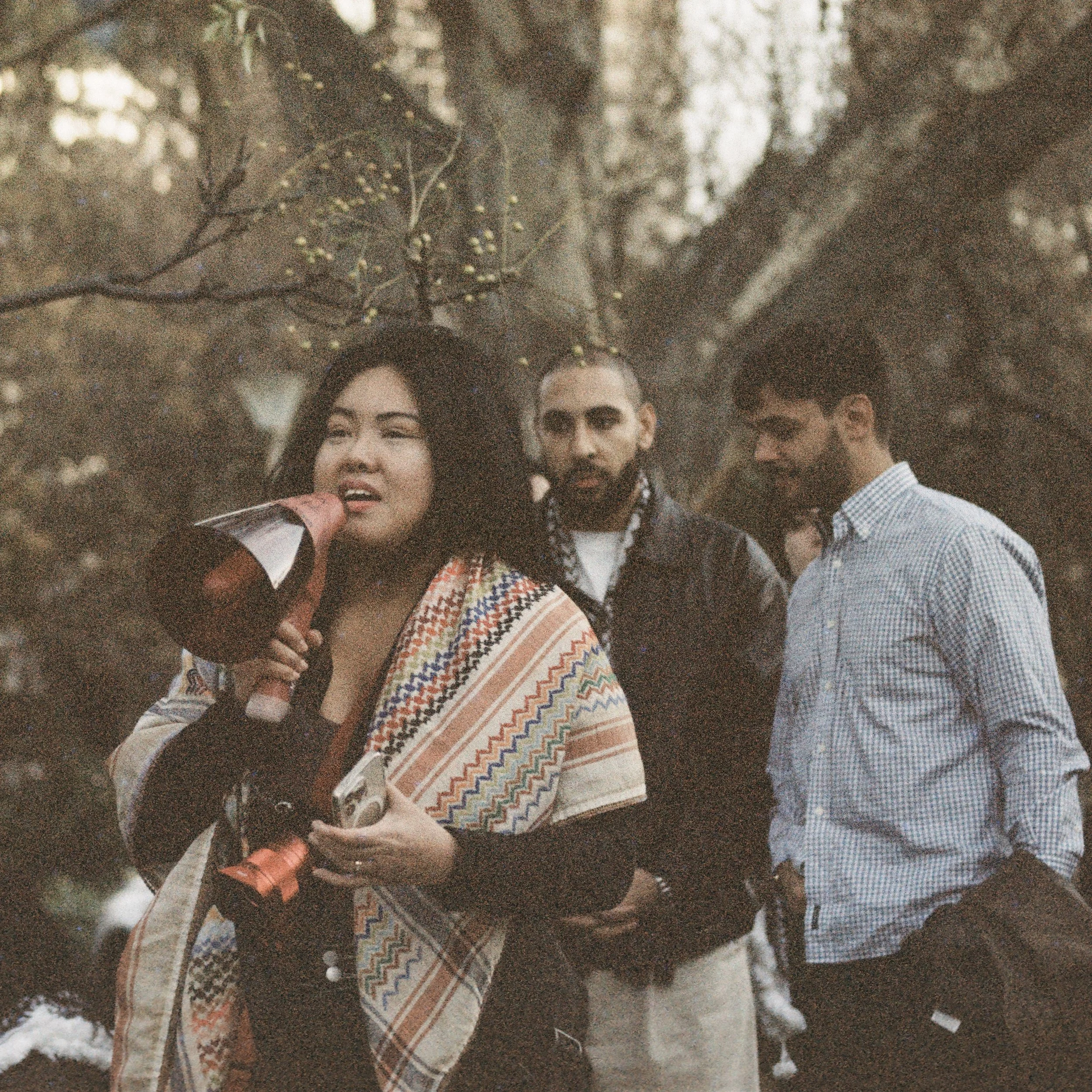
Photo by SanaShoots
a tale of two English professors
speech given by Angelita Biscotti addressing the UniMelb for Palestine Graduation vigil, 9th August 2024
Professor Refaat Alareer was an English teacher and poet, like Ghassan Kanafani a generation before him. Both were assassinated by Israel. I think about what it means to be an English teacher specifically, what it means to devote your life professionally chatting to young people about books and ideas. I've been doing this as a casual tutor in Gender Studies at the University of Melbourne these past two years, and I am now a new PhD candidate in Creative Arts and English.
I remember being a lonely 13-year-old first-year high school student in Manila, falling in love with an English literature teacher who turned out to be a jerk; I dumped him but remained in relationship with English literature. An English professor in so-called Australia--if they are of a certain ethnicity and generation, will live out their lives according to these beats: BA to MA to PhD to tenure, a few affairs their colleagues will find spicy, perhaps children, a property or two in the inner-north, where they get to identify as "working-class", "vagabond" and "revolutionary" even if the figures on realestate.com.au say otherwise. After all they speak French and drink beer, wear glasses and smoke cigarettes, how much more rebellious can you really get as an academic on this continent. They'll get to 50, get a few awards, and self-congratulate for not selling out.
An English professor in or from Gaza might do the BA to MA to PhD journey, juggling partnership, parenthood, teaching, editing and publishing not just scholarly articles or their own poetry, but social justice work on social media that never sleeps, fending off death threats from small-time trolls and big-time 'respectable journalists,' doing global consciousness-raising work for a world that insists on turning a blind eye to the Palestinian people. They can never simply be English teachers talking about books and ideas they love, they have to be always be more than this. They might make it to their late 30s or 40s, only to meet their death by Israel's airstrikes, if not by Israel's indirect killing methods that Lancet medical journal has reported to have claimed 186,000 Gazan lives. To be an academic in or from Gaza means not only fighting for tenure, fighting to land your publications in prestigious journals, competing for grants, but fighting to simply live. To be an academic in or from Gaza, you have to produce your best work on borrowed time because your poetry and research will outlive you, and your words might only reach the wider outside world after Israel's deliberate scholasticide takes you.
To be an English teacher is to be a spokesperson for the humanities and what it means to be human, to say "we, they, you are more than numbers."
I'm going to read a little bit from Professor Alareer's work--not the famous If I Die poem which has been rightly widely read. I'm going to read from his 2017 PhD thesis about the metaphysical poet John Donne, who apparently coined the famous phrase "No man is an island."
"I, spinning like a compass in my grave,
Often there would pause and deeply ponder
On what you people don't get, and wonder
At what you guys just did and gave Why is it a folly what you get not?
O! Who says 'The Flea' is meant to seduce?
It rather awareness in you produce
Why is it smartness what you only got?
Aye, this is my canon lying hither,
Let readers read, then pray and pray and hope
For I am done, more famous than a pope
No matter what you do to hinder.
This you think my verse defames and murders,
Verily has won me more supporters."
Here is an excerpt from his research on John Donne:
“Reading Donne's poetry, we are first amused by the whole situation of presenting traditionally accepted styles and themes so wittily. Upon careful considerations of Donne's corpus, we start to see how authorities are mocked or mimicked, and then by time this emerging unofficial, unwanted narrative, which occasionally makes use of parody and humour, evolves to compete with or deconstruct the established official narratives and styles. Donne presents a role model for emerging writers resisting censorship and a prime example of Bakhtin's concepts of addressivity and answerability: his poetry is usually addressed to posterity, whom Donne calls ‘future rebels’, and anticipates and generates future responses hence keeping it both universal and timeless.”
Here Professor Alareer is talking about the poet John Donne. He could also be speaking about himself. He could be speaking about Gaza.
To read Professor Refaat Alareer’s PhD thesis titled “Unframing John Donne’s transgressive poetry in light of Bakhtin’s dialogic theories”, click here.